The Nation's Nature by James D. Drake
Author:James D. Drake [Drake, James D.]
Language: eng
Format: epub
Tags: History, United States, Colonial Period (1600-1775), Revolutionary Period (1775-1800), Historical Geography
ISBN: 9780813931227
Google: EWV9T2MT5SoC
Publisher: University of Virginia Press
Published: 2011-01-15T17:17:29+00:00
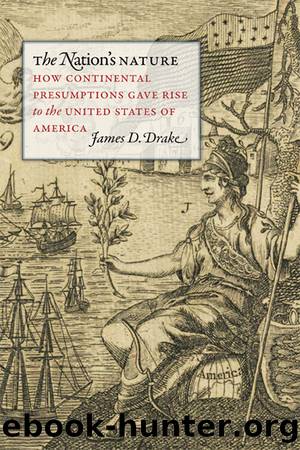
THROUGHOUT the Revolution, satirical prints continued the tradition of representing both the continent and the mainland British colonies as an Indian. For instance, in The Present State of Great Britain (c. 1779), Great Britain appeared as the dozing figure of John Bull while an Indian princess lifted a liberty cap off a pole he held. In another print, The English Lion Dismemberâd (1780), an Indian held a pole with a liberty cap in one hand and an axe in the other. He had just hacked away the paw of the lionâemblematic of Britainâwhile it was chained to Lord North, who carried a heavy sack representing the budget.85
So it was nothing new when patriots attributed human characteristics to their continent. What was new was how they adapted this tradition to their everyday discourse when they identified themselves collectively. It is hard to exaggerate how heavily larded the letters of congressional delegates, military leaders, and diplomats were with the causeââthe continentââacting or being acted on. Just leafing through the papers of Washington, Adams, or virtually any other patriot who left behind a body of correspondence, makes apparent that âthe continentâ could be enslaved, distressed, and burdened. It could have expenses and debts, patience and courage. It could suffer, sacrifice, and bleed. Such anthropomorphism reinforced communal ties among disparate peoples. It took diversity and turned it into a cohesive living organism, an asset greater than the sum of its parts.
American newspapers and pamphlets, too, relied on rhetoric that anthropomorphized the continent in contradistinction to human enemies such as the king or Parliament. Richard Wells, seeking reconciliation between the United States and Britain, warned that the continent was a âformidable figureâ that could stand equal to English officials: âLet English Statesmen clamor for power, let a British parliament boast of unlimitted supremacy, yet the continent of America will contend with equal fervency.â As mentioned earlier, Wellsâs rhetoric anticipated that of Thomas Paine, who argued in Common Sense that âuntil an independence is declared, the Continent will feel itself like a man who continues putting off some unpleasant business from day to day.â The choice, according to Paine, had to be made between the king and âContinental authority.â86
In a sermon appropriately titled The Love of our Country (1777), army chaplain John Hurt combined the anthropomorphism of the continent with a familial metaphor. He told Virginia troops in New Jersey during the desperate times of 1777 that mainlanders were âall children of one common mother, America, our country; she gives us all our birth, nursed our tender years, and supports our manhood. In this light, therefore, our regards for her seem as natural as the implanted affection betwixt parents and children.â87 The people of America were not the continentâs only children. In a whimsical piece published in the United States Magazine, the Continental Dollar told his (her?!) life story in which he was the offspring of father Liberty and mother America, who âfor youth and beauty, far exceeded all the terrestrial painted beauties of Europe, the tawney beauties of Asia, and the charcoal beauties of Africa.
Download
This site does not store any files on its server. We only index and link to content provided by other sites. Please contact the content providers to delete copyright contents if any and email us, we'll remove relevant links or contents immediately.
The Vikings: Conquering England, France, and Ireland by Wernick Robert(84374)
Ali Pasha, Lion of Ioannina by Eugenia Russell & Eugenia Russell(40315)
The Conquerors (The Winning of America Series Book 3) by Eckert Allan W(37892)
The Vikings: Discoverers of a New World by Wernick Robert(37006)
Cecilia; Or, Memoirs of an Heiress — Volume 1 by Fanny Burney(32635)
Cecilia; Or, Memoirs of an Heiress — Volume 2 by Fanny Burney(32010)
Cecilia; Or, Memoirs of an Heiress — Volume 3 by Fanny Burney(31996)
Empire of the Sikhs by Patwant Singh(23135)
The Secret History by Donna Tartt(19291)
Hans Sturm: A Soldier's Odyssey on the Eastern Front by Gordon Williamson(18648)
Cat's cradle by Kurt Vonnegut(15441)
Pimp by Iceberg Slim(14661)
Sapiens: A Brief History of Humankind by Yuval Noah Harari(14458)
Norse Mythology by Gaiman Neil(13457)
Talking to Strangers by Malcolm Gladwell(13438)
Leonardo da Vinci by Walter Isaacson(13407)
4 3 2 1: A Novel by Paul Auster(12505)
Underground: A Human History of the Worlds Beneath Our Feet by Will Hunt(12144)
The Radium Girls by Kate Moore(12089)
